Podcast: Play in new window | Download (10.0MB) | Embed
Subscribe: Apple Podcasts | Spotify | Android | Email | Youtube Music | RSS
Auto-generated transcript:
Bismillāh ar-Raḥmān ar-Raḥīm, al-ḥamdu lillāhi rabbil-‘alameen, wa-salātu was-salamu ‘ala ashrafil anbiyā’ wal-mursaleen, Muḥammadur Rasūlullāh sallallāhu ‘alayhi wa-sallam, taslīman kathīran.
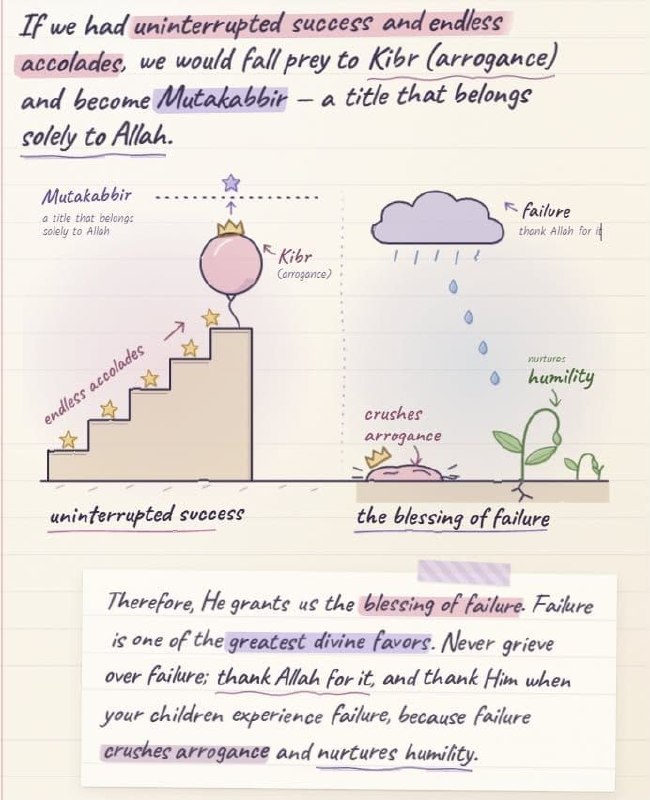
My brothers and sisters, one of my very good friends, Ashraf Buhari, sent me a wonderful little reminder which says, if we had uninterrupted success and endless accolades, we would fall prey to kibr and become mutakabbir—a title that belongs solely to Allahﷻ. Therefore He grants us the blessing of failure. Failure is one of the greatest divine favours. Neither grieve over failure, thank Allah for it, and thank Him when your children experience failure, because failure crushes arrogance and nurtures humility. May Allah save us from all tests. So while this is very important to remember, when you have failures, we don’t ask for failure as such. But when you do have failure, and failure is part of life, then then we don’t get despondent and we don’t grieve over it. And we say, Alhamdulillah. The important thing to understand here is that failure is something that comes for everyone, including Rasulullah Sallallahu Alaihi Wasallam. When we saw in Badr, there was success and in Uhud, immediately thereafter, there was failure—and such serious failure that Rasulullah himself was injured. Similarly you had success in Fatah Makkah and then immediately thereafter in the Battle of Hunayn there was failure. And Allah showed us and He mentioned that how it was the mercy of Allah that Allah helped helped them with forces that they could not see, and as a result of which Hunayn was then converted from failure to victory, but initially it was a complete rout.
He says that if Allah Subh’anaHu Wa Ta-A’la loves somebody, then He reminds him of his failures, and he reminds him of his sins over and over again so that the person can make istighfar again and again. Now, of course, we know that once Allahﷻ has forgiven, he’s forgiven. Istighfar, once you make it once, you don’t have to make it 10 times. But the reason why you make it 10 times is because this is the nature of the slave. This is the nature of us as the ibadah of Allahﷻ, as the slaves of Allahﷻ, that we don’t take things for granted. We say, Alhamdulillah, I asked Allah’s forgiveness, but I will ask Allah’s forgiveness another million times. Because even though I asked His forgiveness and Allah promised to forgive, I don’t take it for granted. I don’t say, well, you know, I asked Him and Allah promised to forgive, so it’s gone. No, I don’t do that. I say, no, Alhamdulillah, Allah promised to forgive, and of course, Allah’s promise is always true. So I’m not doubting the promise of Allah subhanahu wa ta’ala but at the same time I also don’t take it for granted, I don’t say okay Allah is forgiven, no I make sure that continuously seek the forgiveness of Allah subhanahu wa ta’ala and so also it is very important that if you do something good then do it and forget it—don’t remember it, don’t remember it don’t, definitely I definitely don’t remind anybody about it.
So if you do something good, forget it. But if you do something wrong, then remember it again and again, and keep on asking for the forgiveness of Allah Subh’anaHu Wa Ta-A’la.
Having said that, Allah Subh’anaHu Wa Ta-A’la promised to forgive us, and therefore we never despair of the mercy of Allah Subh’anaHu Wa Ta-A’la. Allah Subh’anaHu Wa Ta-A’la said: “O My slaves, O My slaves who have transgressed against themselves, do not despair of the rahmat of Allah Subh’anaHu Wa Ta-A’la, of the mercy of Allah Subh’anaHu Wa Ta-A’la.” إِنَّ اللَّهَ يَغْفِرُ الذُّنُوبَ جَمِيعًا (Inna Allaha yaghfiru dhunuba jami’an)—Verily Allah Subh’anaHu Wa Ta-A’la forgives all sins. إِنَّهُ الْغَفُورُ الرَّحِيمُ (Innahu al-Ghafur ar-Rahim)—He is the one who is the most forgiving, the most merciful. I remind myself and you that we should always remember the mercy of Allah Subh’anaHu Wa Ta-A’la and always seek the mercy of Allah Subh’anaHu Wa Ta-A’la. And the seeking of the mercy of Allah Subh’anaHu Wa Ta-A’la is not to commit sins; it’s the opposite. It is to not commit sins and to save yourself and to protect yourself from sins and then still seek the forgiveness of Allah Subh’anaHu Wa Ta-A’la. Because no matter how much we protect ourselves, there is some semblance of sin, of something we do and which we should not do. Maybe it’s a sin, if not of action, maybe it’s something else. And so to think about this, that if we can do, if we make sure that we do not commit any sin and be very careful with that, so that eventually we come out of this, when we come to the end of our lives, we will have, inshallah, the mercy and the forgiveness of Allahﷻ. Never take it for granted, because Allahﷻ promised to forgive.
My brothers and sisters, it is Rasulullah Sallallahu Alaihi Wasallam who is the best of examples, and if you see how even though he, sallallahu alayhi wa-sallam, Allah had promised, and Allah revealed Quran that He has forgiven him, yet Rasulullah used to beg forgiveness of Allah. He would recite istighfar 75 to 100 times a day. The Sahaba actually counted when he used to do this. He would stand in Salah, and he would make sujood in Salah, and he would stand sometimes so long that his blessed feet would swell up. And Sayyidina Aisha, our mother, she said that it looked as if the skin would burst—you know, the feet were so swollen. And she asked him; she said, “Ya Rasulullah, Allah has forgiven you, He has forgiven your sins, you know, whatever you may have done or not done, whatever you may, you know, in the past and the future.” And then when we say this, it’s not as if the Nabi Alayhi Salaam did since he did not, because he is protected by Allah Subh’anaHu Wa Ta-A’la, yet still, you know, the levels of people are different. So, whatever it is, Allah Subh’anaHu Wa Ta-A’la has forgiven. He said, why do you exert yourself so much? Why do you, you know, put yourself to so much of pain? Because she felt bad seeing him, you know—within quotes, if you understand the word, suffer in this way. He said, should I not be a grateful slave? Should I not be an abd and shakura, you know? Should I not be a grateful slave?
Now this is the whole thing of being, you know, the ubudiyat, the whole point of ubudiyat is to understand our relationship with Allah Subh’anaHu Wa Ta-A’la. Allah Subh’anaHu Wa Ta-A’la is our creator. Allah Subh’anaHu Wa Ta-A’la is the one to whom we owe everything, right? Mentioned this in the Quran, Allah said: “How is it that you can deny Allah? You were dead. Then He gave you life. Then He will give you death again. Then He will give you life again. And then you will return to Him.” كَيْفَ تَكْفُرُونَ بِاللَّهِ وَكُنتُمْ أَمْوَاتًا فَأَحْيَاكُمْ ثُمَّ يُمِيتُكُمْ ثُمَّ يُحْيِيكُمْ ثُمَّ إِلَيْهِ تُرْجَعُونَ (Kayfa takfuroona billahi wa kuntum amwaatan fa-ahyaakum thumma yumeetukum thumma yuhyeekum thumma ilayhi turja’oon). Allah Subhanahu wa Ta’ala mentioned this—it’s how can you deny Allah Subhanahu wa Ta’ala now; denying is it’s not just you know like straightforward Kufr may Allah protect us where we say there is no God or when people say that there is no God and so on. You know, I’m not talking about that. I’m saying disobedience is a way of denying because when you are disobeying, you are, the person disobeying is denying the lordship of Allah Subh’anaHu Wa Ta-A’la. He’s denying the authority of Allah Subh’anaHu Wa Ta-A’la. Allah Subh’anaHu Wa Ta-A’la made something halal or made something haram and we still do it. Allah Subh’anaHu Wa Ta-A’la made something halal and we have made it haram on ourselves. Allah Subh’anaHu Wa Ta-A’la prohibited something but we still do it and so on. Now, all of this is denying the lordship of Allah, denying the authority of Allah. So this is a form of kufr, right? It’s a form of kufr because if Allah has told us don’t do something but we still do it, then what does it show? It shows that I don’t care about Allah. I don’t care about the authority of Allah. So Allah is saying, how can you do that? How can you disobey and how can you deny whatever the so-called level of denial is? When you are dead.
The first ayat of Surah Al-Dahar, where Allah says, “Has humankind, has mankind forgotten the time that there was a time when they, even their mention wasn’t there, right? You did not exist. You simply did not exist. You’ve forgotten this time.” Allah is the one who gave you life. And Allah is the one and now remember Allah gave you life and in this life Allah gave you authority; He gave you choice; He gave you strength; He gave you resources; He gave you the power to disobey Him if you want but He also gave you the power to obey Him if you want. And then of course Allah Subhanahu wa Ta’ala one day will take it away—one day you will die and then you will be resurrected and you will return to Allah Subhanahu wa ta’ala—and it doesn’t matter whether you believe that or not, that is going to happen. But this is something that we must constantly remind ourselves and not fall into this trap of becoming mutakabbir. If Allah Subh’anaHu Wa Ta-A’la blesses us, then constantly thank Allah Subh’anaHu Wa Ta-A’la. Constantly say, Alhamdulillah, Alhamdulillah, Alhamdulillah. Don’t take it for granted. And if we have difficulties, if we have failures, then say, Alhamdulillah. Nabi Sallallahu Alaihi Wasallam would say, Alhamdulillah, Alhamdulillah. Alhamdulillah—all praise and thanks to Allah in every situation, every state that we are in. We ask Allah to help us to be grateful slaves and to be always thankful and to be always in His abudiyah to make sure that we fulfill the rights of His abudiyah.