Podcast: Play in new window | Download (13.5MB) | Embed
Subscribe: Apple Podcasts | Spotify | Android | Email | Youtube Music | RSS
Auto-generated transcript:
Bismillah ar-Rahman ar-Rahim, Alhamdulillahi Rabbil ‘Alameen.
Wa salatu wa salamu ala ash-sharafi lam ya’i wal mursaleen Muhammad wa Rasulullah ﷺ, Tasliman Fathirin Fathirin. I want to share with you a dua that Rasulullah ﷺ used to teach anyone who entered Islam. As soon as a person entered Islam, Rasulullah ﷺ would teach him this dua.
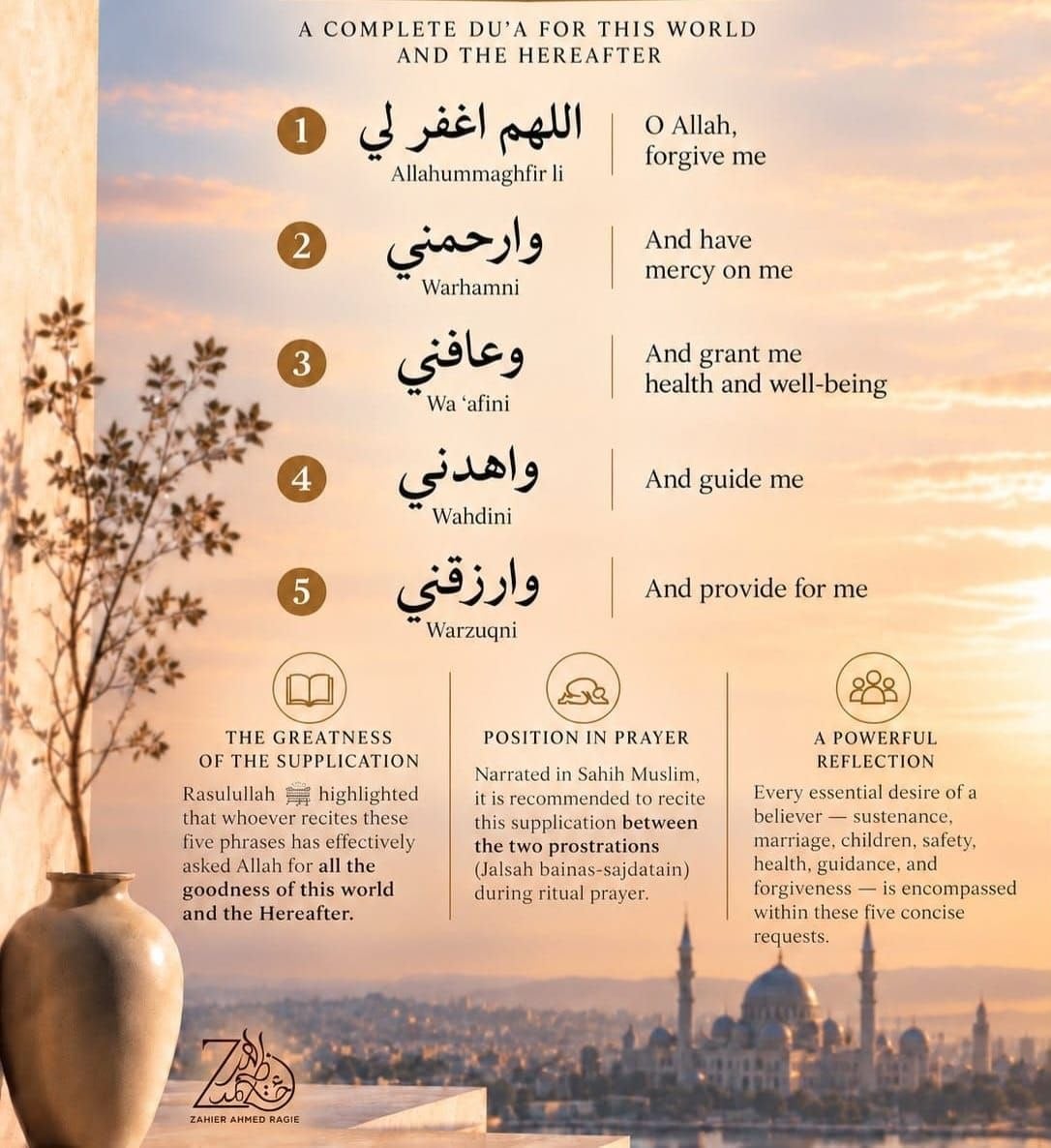
It’s a very simple dua. Actually, it’s a dua which we also recite between the two sajdas. When you sit down in the Jalsa, after the first sajdah, you recite this dua and then you go into the second sajdah. The dua is: Allahumma khfirli wa rahmatullahi wa barakatuhu. Wa rahamni wa afini wa ahdini wa rizuqni. Five things.
Allahumma khfirli, O Allah forgive me. Wa rahamni, have mercy on me. Wa afini, give me afiyah, give me blessing in everything, health, well-being. Wa ahdini, Guide me. Wa rizuqni. And give me rizq. Provide for me. So if you don’t know this dua, please memorize it. Very simple dua. Allahumma khfirli, wa rahamni, wa afini, wa ahdini, wa rizuqni. This is a dua that Rasulullah ﷺ used to teach anyone who entered Islam. And we ask Allah to help us to make this dua. This is among the blessings of being in the Ummah of Rasulullah ﷺ. Is that we know and we have access to all the different duas that he used to make? And Rasulullah ﷺ used to make dua for everything. Dua before eating food, dua after eating food.
Dua if you leave the house, dua when you come back into the house. Dua when you are travelling. Dua when you arrive. Everything. I mean you name it. Including dua when you enter the toilet and dua when you come back out of the toilet. So everything. Rasulullah ﷺ used to make duas. And it’s a good thing to memorize these duas. Because Alhamdulillah Allah ta’ala did not put a condition. Allah ta’ala did not put a condition on dua. Allah ta’ala said, Astajib lakum, ask me I will give you. And Allah did not put any condition on this. Allah did not say ask me in a state of wudu, ask me in a state of purity, ask me facing the Qibla, ask me raise your hands, ask me when you are sitting on the Musalla, ask me after praying two rakaat of Salat. All of these things which we do are Alhamdulillah they are very good things to do. These are ways of making dua. And dua is even more effective. Nothing wrong with this. All of these are good things. But Allah did not make them conditions upon conditional for the dua to be accepted. Because dua is something you ask in an emergency. I need help right now. I have to ask. So Allah made it very easy. Allah said you ask. Any language, anywhere, anyhow. You have a need, ask. And inshaAllah Allah ta’ala will give. Obviously when you have some time if you ask in these ways, ask at certain times. For example the time between Adhaan and Iqamah. This is the time for the acceptance of dua. Right? Prophet ﷺ said there is two rakaat of Nafil after the Adhaan. So every Salah after the Adhaan, praying two rakaat of Nafil is mustahab. This is a good thing. This is a blessing from Allah. If you do it, it’s a matter of khair and barakah for you. You must do it inshaAllah. Don’t be in a hurry to immediately start praying. Pray the two rakaat of Nafil. Make dua. Then pray. Allah accepts duas.
Dua after listening to the Adhaan. Prophet ﷺ said if a person listens to the Adhaan, let him repeat after the Mu’adhin. Whatever the Mu’adhin says, the words of the Mu’adhin, let him repeat those words. When the Mu’adhin says, Hayal as-Salahi, Hayal as-Farah, let him say also: La Hawla wa la quwwata illa Allah. Then let him send Salat and Salam on me. This is something we forget. Immediately make the dua of Adhaan. No, between the Adhaan and the dua of Adhaan, there is Duru Sharif. There is Salat and Salam on the Prophet ﷺ. So do the thing as the Prophet told us to do it. Don’t invent. So the Prophet ﷺ said send Salat and Salam on me. So we send Duru and the Prophet ﷺ. Then we make the dua of Adhaan.
Allahumma Rabb’ha a’zizawati al-taamma wa salatil qaima aati Muhammadan al-wasilata wal-fadila wa ba’asu maqaman mahmooda alladhi wa a’ta. And after that, he said whatever dua you make, Allah will accept it. Then dua in tahajjud. Allah subhanahu wa ta’ala descends to the first heaven in a manner which suits His Majesty and Grace. And Allah subhanahu wa ta’ala announces, like I mentioned yesterday, the day before yesterday. Allah announces, Ana malik, Ana malik, I am the King, I am the King. Al malikul quddus, al malikul haqq, la ilaha illa huwa rabbul arshi al kareem. This is the Shah of Allah. And Allah says, let the one who has a need, let him ask me, I will give him. The one who needs protection, let him ask me, I will protect him. The one who needs forgiveness, let him ask forgiveness, I will forgive him. So all of these things are ways of getting the dua accepted. So these are all good things. But Allah gave us the ability and the permission to ask Him in any state and any form. So Rasulullah used to ask and therefore obviously the duas of the Rasul supersede and they are better than any dua that we can make. And so therefore memorize, try and memorize those duas and ask Allah in those ways.
Now in the Sahaba, aridhu Allahi alaihi wa alaihi wa min, the many ahsanat and the many good deeds, the many favours that we have, thanks to the Sahaba we have, the Sahaba’s favour on us, if you look at it in that sense. And we ask Allah to reward the Sahaba for these favours. And these favours were the questions that they asked Rasulullah ﷺ. Because it is because of the questions of the Sahaba, aridhu Allahi alaihi wa alaihi wa min, that the deen becomes clear to us. So one of the Sahaba, he said, Ya Rasulullah, you make so many duas. For everything, you know, every action, everything. You make duas, lots of duas. We cannot, at least I cannot memorize all of them. My memory is not so good. I cannot memorize all these duas. So teach me one dua. Teach me one dua which encompasses all of these duas. In one dua I must get the benefit of all the duas that you made. See the beautiful question he is asking. Rasulullah taught him these duas. That is another something for us to memorize and do it. He said, make this dua, ask Allah:
Allahumma inni asaluka min khairi ma sa’alaka minhu nabiyuka Muhammad sallallahu alaihi wa sallam wa na’udh bika min sharri musta’ataka minhu nabiyuka Muhammad sallallahu alaihi wa sallam wa antan musta’an wa alaika albalaaq wa la huwa la wa la quwwata illa billahi illa rizqi.
He said, O Allah, give me all the goodness that your Nabi used to ask. So everything that Nabi asked which was good. Give me all of those. And O Allah, protect me from all those things that your Nabi used to seek protection from. That was one dua. He got everything. He said, O Allah, give me all of the things that your Nabi used to ask you for. And protect me from all of those things that your Nabi Muhammad ﷺ used to ask protection from. Wa antan musta’an. And you are the one who can help. Wa alaika albalaaq. And to you is all glory and all majesty. wa la huwa la quwwata illa billahi rizqi. And there is no one who has any quwwata and any taqata and any irada and any ability other than you, Jalla Jalaluhu. So this is something that I remind myself of. Let us try to do this. Try to memorize duas. And this particular dua is very very important.
So in this context as I mentioned to you, Nabi used to teach this beautiful dua to anyone who came into Islam. And the beautiful dua is: Allahumma ghafir li wa rahamni wa aafini wa ahdini wa rzukh. Five things. As I mentioned to you, this is a dua that we also do. So it is recommended that between the sajdahs, when we sit in Jalsa, this is the dua to make. So you have to get up from the first sajdah, Allah Haq Bar, make this dua, then go into the second sajdah. This is the dua between these sujoods. On a side note, this is also one of the ways in ensuring that this salah is correct. Because many people, they make this big mistake where they don’t complete a rukun.
Before, sort of halfway, you go and you do it again. So you have people who will go into rukun and they don’t even fully stand up. They just go halfway up and then they go into sajdah. And similarly, they go into sujood and they don’t get up fully and they go into the second sajdah. This, this depending on how you do it, it can actually invalidate your salah. Your salah becomes worthless. Or definitely it’s a major defect in the salah. We have this famous hadith of, it’s called the man who did not pray. And the hadith is that this man came, Nabi was in the masjid. And this man came, he prayed two rakat and then he came to Nabi and he greeted him. He said salaam. Rasul did not reply to his salaam. He said, go back, you have not prayed. Pray again. So the man went back and he prayed again. Then he came again and he made salaam. Nabi did not say waalaikumussalam. He said, go back, you have not prayed. Pray again. So second time he went back, he prayed two rakat. He came back, Nabi said the same thing to him. He said, go back, you have not prayed, pray again. He prayed a third time. Then he came back, Nabi said to him the same thing. The man said, Ya Rasulullah, I only know this much.
He said, that’s all I know. I mean, I’m a Muslim. I’m praying but if I’m making a mistake, that’s all I know. Then Nabi taught him the salaam and he said to him this thing. He said to him that one of the problems is the way you are praying, which is not getting up fully, not standing. Rasulullah ﷺ said, after every rukun in salaam, complete the rukun and stand and stay there until your bones have settled. Right? You bend down, get up, fine. No. Get up fully. And that’s the reason why after in all these gaps there is things to be said. You stand up and say, Rabbana lak alhamd. Right? The Imam says, samiulaha wa li wal hamidah. And if you are praying on your own, you say both. And then you say, Rabbana lak alhamd. So at least there is some space. Then you go into the sujood. And then after you get up from sajda, Allahumma khfirli wa rahamni wa aafini wa ahdini wa rukuni. Then the second sajdah.
Right? There are two kinds of mistakes you make. One is this. The other mistake we make is the opposite. Which is people, for example, after the second sajdah, they will sit there. You are supposed to stand up. Right? This is between the two rakat. There is no jalsa there. Now they sit there. For what? So you are creating a movement there. You are creating something which does not exist. So your salya gets invalid. I am not saying get up like a jack in the box, boom. No. But it is a continuous movement. So when you get up, when you get up from the sujood, you sit and stand. At the same time, you stand up. You don’t just sit there. So two kinds of mistakes. One is not enough time. Two is too much of time. Right? Both are mistakes. Both can invalidate the salah. And it makes no sense. I mean, you take all the time and trouble, you make udu and you do this and that, and you come and you pray, and then you pray in a way which destroys the salah. What sense does it make? So it is very important for us to learn to pray correctly. And these are apparently small things, but these things are very serious. They are not small things. They are very serious things, which we must pay attention to and do. And concentrate and ensure that we pray correctly. When you are praying, alhamdulillah Allah has given us tawfiq to pray. Let us ensure that we also pray correctly so that the prayer is not invalidated. We ask Allah to accept our prayers, accept our duas, accept our sala, accept our ibadat, and to help us to worship Him in a way that I won’t say suits His Majesty and grace, because we can never achieve that. But that which He will find acceptable, which He will forgive us for, and which He will take from us, inshaAllah. Wa sallallahu ala nabiyyil kareem wa ala alihi wa sahbihi ajma’in. Bi rahmatik ya Rahman Rahim.